

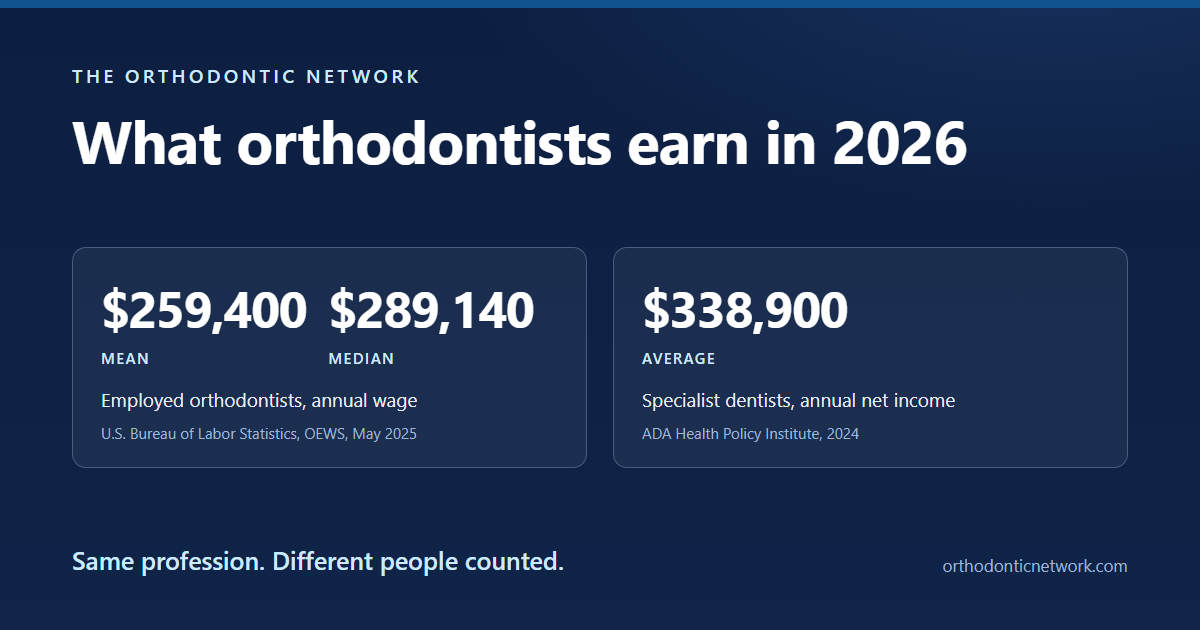
Two numbers get quoted most often when orthodontists talk about pay. The U.S. Bureau of Labor Statistics put the mean annual wage for orthodontists at $259,400 in May 2025, with a median of $289,140. The American Dental Association's Health Policy Institute put average net income for specialist dentists at $338,900 in 2024.
Both are accurate. They count different people in different ways, which is why an associate reading one figure and an owner reading the other can each come away sure the other number is wrong.
What follows is what sits underneath them: how orthodontists are actually paid, what changes between an associate position, a DSO and ownership, and what the published numbers can and cannot tell you.
The public numbers disagree because they count different people
The BLS figure comes from the Occupational Employment and Wage Statistics program, which asks employers what they pay wage-and-salary employees. It counted 6,210 orthodontists in May 2025. An orthodontist who owns a practice and takes profit rather than a wage is not in that count at all, so the figure describes employed orthodontists and no one else.
The ADA figure comes from its Survey of Dental Practice and reports net income rather than wages, which is why it runs higher. It reports specialists as one group: oral surgeons, endodontists, orthodontists, periodontists and pediatric dentists together. There is no orthodontist-only line in the public report.
Job boards and salary aggregators average whatever postings they hold at the time. A posting is an offer, not a pay stub, and the mix of offers changes month to month.
None of the three is wrong. They answer three different questions, and none of them answers the one most orthodontists are asking, which is what this particular job, in this particular setting, is likely to pay.
A rough rule holds up well enough to use. If you are employed and paid a wage, the BLS range is the closer description of your position. If you own a practice, the ADA net income figure is the closer one, with the caveat that it carries four other specialties inside it. If you are a resident reading either number before a first contract, treat both as background rather than as a forecast of your first year.
An associate is most often paid by the day
In orthodontics, individual production is difficult to attribute cleanly, because treatment runs over months and the practice collects against a contract rather than a visit. That is the practical reason a daily rate is the most common structure for an orthodontic associate, as one dental CPA firm explained when it published its compensation guidance in 2021.
The ADA sets out four compensation models for dental associates: straight salary, paid annually, monthly or by the day; salary plus a commission on production; straight commission; and net profit, meaning billings minus specified expenses.
The detail that moves money is what the percentage attaches to. The ADA's own example is worth keeping in mind: 30% of $1,500 in production pays $450, while 35% of $950 in collections pays $332.50. The larger percentage pays less. Production, adjusted production and collections are three different bases, and an offer that names one without defining it is an offer with a gap in it.
A DSO changes what is fixed and what is yours to decide
A practice is DSO-affiliated when an outside entity manages some or all of the non-clinical functions, such as billing, marketing or human resources. That is the ADA Health Policy Institute's definition, and it is broader than ownership.
The same report puts DSO affiliation among all U.S. dentists at 16.1% in 2024, up from 7.2% in 2015, and at 26.5% for dentists up to 10 years out of school. Within orthodontics, the American Association of Orthodontists recorded 14% of members in DSO or OSO settings in its 2023 survey, compared with 6% in 2018, and 28% of members under 35.
The ownership side of the same survey moved in step. Orthodontist-owned single or group practices accounted for 71% of respondents in that survey, down from 91% in 2014, 84% in 2016 and 80% in 2018. Whatever an individual orthodontist concludes about the trade, the composition of the profession is changing, and a resident choosing a first job today is choosing in a different market from the one their mentors entered.
What is published about the pay itself is thinner than the conversation around it. The structures commonly described are a salary with a bonus, with benefits attached, and with fees, scheduling and staffing decided above the chair rather than at it. No public survey breaks orthodontist earnings out by DSO and private practice, so anyone offering a clean comparison of the two is offering an impression rather than a measurement.
Coming soon: private practice or DSO, what changes in what you earn and how you work.
An owner is paid what the practice has left
The AAO's 2025 Economics of Orthodontics survey reports that 68% of respondents own a practice, solely or as a partner, while 60% of respondents under 35 are employees.
An owner's income is profit after overhead, not a wage. That is the reason owner figures sit higher on average and vary far more widely: two practices with the same collections and different overhead produce two different incomes. The ADA's income report also notes that owner dentists work about five hours more a week than employees and associates, and that the income gap between the two has been narrowing among general practitioners.
The same AAO survey reports that 40% of respondents saw their salary rise in 2024, with the average reported salary up 16% against the 2022 survey. It gives percentages rather than dollars, which is a fair description of what is publicly measured.
The same survey reports patients in active treatment per member rising from 574 in 2022 to 696 in 2024. Chair time, staffing and case mix sit between that number and an owner's income, so a busier practice is not automatically a more profitable one. It does sit alongside the rise in reported salaries in the same survey, which is as much as the published data supports.
What an associate offer looks like on paper
The one published range in circulation for orthodontic associates is $900 to $1,600 a day, from that same CPA firm's 2021 guidance. It is one firm's experience from five years ago rather than a survey, and it is the best public reference point we have found.
The arithmetic is worth doing before a conversation rather than during one. Four days a week for 48 weeks turns $900 a day into roughly $173,000 and $1,600 a day into roughly $307,000, before benefits and before anything production-based sits on top. Both ends of that span assume a full calendar, which few first years deliver, so the honest version of the figure is lower than the arithmetic.
A daily rate is also silent about several things that cost real money. Health insurance, malpractice coverage, continuing education, licensure and a retirement contribution are each either in the offer or out of it, and an offer that is quiet about them is usually quiet for a reason worth asking about.
Four questions settle most of the ambiguity in an offer. What is the model, in writing. What exactly does the percentage attach to, production, adjusted production or collections. Who pays for lab fees, assistants and supplies. And what happens to the base after the first year, since the common hybrid runs 6 to 12 months of base pay plus a percentage of collections before moving to collections alone.
Coming soon: associate orthodontist salary, how compensation is structured and what to ask before you sign.
Every one of these numbers sits on top of debt
The American Dental Education Association reports that the average educational debt of indebted dental school graduates in the class of 2025 is $297,800. That is dental school alone.
Residency adds two to three years on top of it. The University of Alabama at Birmingham, a public program, publishes a 30-month course at about $13,000 a year in tuition and fees, plus roughly $15,000 for instruments, a camera, a laptop, books and supplies. Private programs charge considerably more, and several publish their tuition only to applicants, so the spread between programs is part of what a resident is choosing between.
The AAO puts average debt for members under 35 at $344,000. A first-year income is read against a repayment schedule, which is why two orthodontists can look at the same offer and reach opposite conclusions about it, and why both can be right.
Where you practice changes the number
Pay varies by state and by market, sometimes by more than the difference between two settings in the same city. We would rather measure that than estimate it, so the figures are not in this post.
Coming soon: orthodontist salary by state, how much it varies and why.
The questions orthodontists ask each other
The numbers above are the published part. The part that decides careers tends to be asked privately, between people who trust each other: is a daily rate of this size fair in this market, what percentage is reasonable in year two, how does a bonus actually pay out once the targets are read closely, what does buying in really cost, and what would you have asked before you signed.
Those questions rarely get answered in public, because the person who knows is the person who signed something similar last year and has no particular reason to publish it. That is the conversation the Network exists to make possible, among verified peers, and we are at the beginning of it rather than the end.
If you have been on either side of one of these offers, your experience is worth more to a colleague than any survey on this page. We would be grateful to hear it.
The future of orthodontics is connected.
Questions we hear most often
How much do orthodontists make a year?
For employed orthodontists, the BLS reported a mean annual wage of $259,400 and a median of $289,140 in May 2025. The ADA's Health Policy Institute reported average net income of $338,900 for specialist dentists in 2024, a group that includes orthodontists alongside four other specialties. Owners are paid profit rather than a wage, so their income is both higher on average and far more variable.
Do orthodontists make more than dentists?
On the published averages, yes. The ADA put average net income for specialist dentists at $338,900 in 2024 against $207,980 for general practitioners. Specialists are reported as one group, so the figure is not orthodontists alone.
Do orthodontists at a DSO earn less than in private practice?
No public survey measures orthodontist pay separately for the two, so the honest answer is that nobody can say from published data. What is measured is the shift itself: 16.1% of U.S. dentists were DSO-affiliated in 2024, and 14% of AAO members worked in DSO or OSO settings in the association's 2023 survey.
How much do orthodontists make straight out of residency?
There is no published figure for first-year orthodontists specifically. What is published is the context: 60% of AAO respondents under 35 are employees, their average debt is $344,000, and associate compensation is most commonly set as a daily rate rather than a salary.