
Patients ask AI assistants questions now. They type a whole sentence instead of two words, and what comes back is a short answer rather than a page of links.
That changes a practical question for every practice. If a page of ten results is not what the patient sees, what decides whether your practice is in the answer at all?
Two guides offer a useful starting point. Google explains what its AI search features require. The AAO offers practical advice for orthodontic practices.
What Google says it requires
Google publishes the requirements itself, in its documentation on AI features in Search. The technical bar is one sentence:
To be eligible to be shown as a supporting link in AI Overviews or AI Mode, a page must be indexed and eligible to be shown in Google Search with a snippet
Then, under its best practices, Google says what is not needed:
You don't need to create new machine readable files, AI text files, or markup to appear in these features. There's also no special schema.org structured data that you need to add.
Read that twice if a vendor has quoted you for the opposite. It is Google's own page, and it was saying this on November 22, 2026.
One limit on it. Google is describing its own AI features. It is not describing ChatGPT, Claude, Perplexity, or any AI assistant that is not Google's.
What the profession's own guide says
The American Association of Orthodontists publishes a technical guide to optimizing an orthodontic practice for AI search, written by Melissa Sorensen on July 22, 2026, crediting the Association's digital marketing partner Steady Rain.
It takes a different view of markup:
Schema markup provides details that a crawler may not get from scanning page content alone.
It recommends two kinds in particular. Local Business schema, which in the guide's words "communicates your location, hours, contact information, and service area to crawlers." And hasOfferCatalog, to list the services a practice provides.
Both documents are named, dated, and open to anyone. We are not going to tell you which one to follow. We will say the thing that is true of both.
What neither of them shows
Neither document publishes a practice that was named by an AI assistant because of its markup, or passed over for the lack of it.
Google states a requirement. The Association's guide gives advice. Neither is a test, and no test either way has been published that we have been able to open and read.
Google requires no special markup for its AI search features. The AAO recommends structured data to describe your practice. Its impact on AI recommendations remains unclear.
Where the two agree
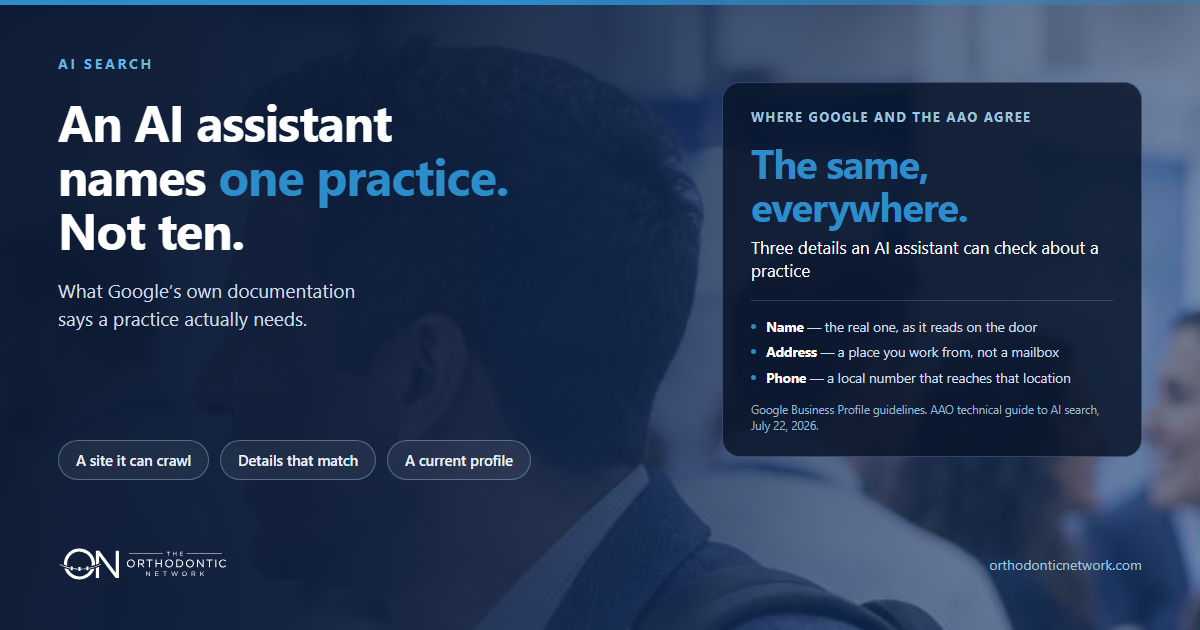
They agree on the part that costs nothing and is easy to check: your details have to be consistent and they have to be true.
The AAO's guide puts it this way:
Ensuring information about your practice is consistent across local listings and platforms is important for establishing this confidence.
Google's representation guidelines for a Business Profile say what consistent and true mean, as rules rather than advice:
- The name is the real one. "Represent your business as it's consistently represented and recognized in the real world across signage, stationery, and other branding."
- The address is a place you work from. "P.O. boxes or mailboxes located at remote locations aren't acceptable," and a rented mailing address you do not operate out of, "also known as a virtual office," is not eligible for a profile at all.
- The phone reaches that location. "Provide a phone number that connects to your individual business location," and use a local number rather than a central call center line.
These are not suggestions. Google says it "reserves the right to suspend access to Business Profiles on Google or other Google Services to individuals or businesses that violate these guidelines."
A suspended profile is not a ranking problem. It is an absence.
What a practice can check
Not a position. There is no position in a sentence.
What a practice can check is whether one version of itself agrees with every other version: the same name, the same address, the same phone, on the website, on the Business Profile, in the directory. That is the only thing about your practice an AI assistant can check.
FAQs
How do patients find an orthodontist using AI?
They ask a question in plain language and get a short answer naming one or a few practices rather than a page of ten links. Google's documentation says a page is eligible to be cited in AI Overviews and AI Mode when it is indexed and eligible to be shown with a snippet. Beyond that, what an AI assistant can confirm about a practice is its published details: the name, the address, the phone number, and whether those agree across the places they appear.
Do I need special code, a file or schema on my website to appear in AI answers?
Google says no. Its documentation on AI features states: "You don't need to create new machine readable files, AI text files, or markup to appear in these features. There's also no special schema.org structured data that you need to add." The AAO's own technical guide, published July 22, 2026, does recommend Local Business schema and hasOfferCatalog. Neither document publishes a result showing what the markup changed. Google is also describing only its own AI features, not other AI assistants.
Does my Google Business Profile change whether an AI assistant recommends my practice?
Google's representation guidelines require the real-world business name, a location you actually operate from, and a phone number that connects to it. A PO box or a virtual office is not eligible. Google says it reserves the right to suspend a profile that violates the guidelines. A suspended or missing profile removes the record an AI assistant would check, which is a different problem from ranking lower.
Why does an AI assistant name one orthodontist instead of showing several?
Because the answer is a sentence, not a list. A search results page has room for ten; a short written answer does not. That is a change in the shape of the answer rather than in how any particular practice is judged, and neither Google's documentation nor the AAO's guide publishes the rule that decides who is named.
What should an orthodontist check first if their practice is not appearing in AI answers?
Start with what is checkable. Is the site indexed by Google, and are its pages eligible to be shown with a snippet, which is Google's stated bar. Is the Business Profile live, with the real name, a staffed address, and a phone that reaches the practice. Do the name, address and phone match on the website, the profile and any directory listing. Those are facts you can confirm today, before paying anyone for anything you cannot.
What the Network is
The Orthodontic Network is a private professional community where U.S. orthodontists and orthodontic residents connect, learn, mentor, and grow throughout their careers. Every member is verified. Members can ask candid questions, share what they've learned, and connect with colleagues who understand the day-to-day experience of practicing orthodontics.
Related reading
For how this showed up in the profession's own reporting this autumn, see what AI has already changed about how patients find an orthodontist.